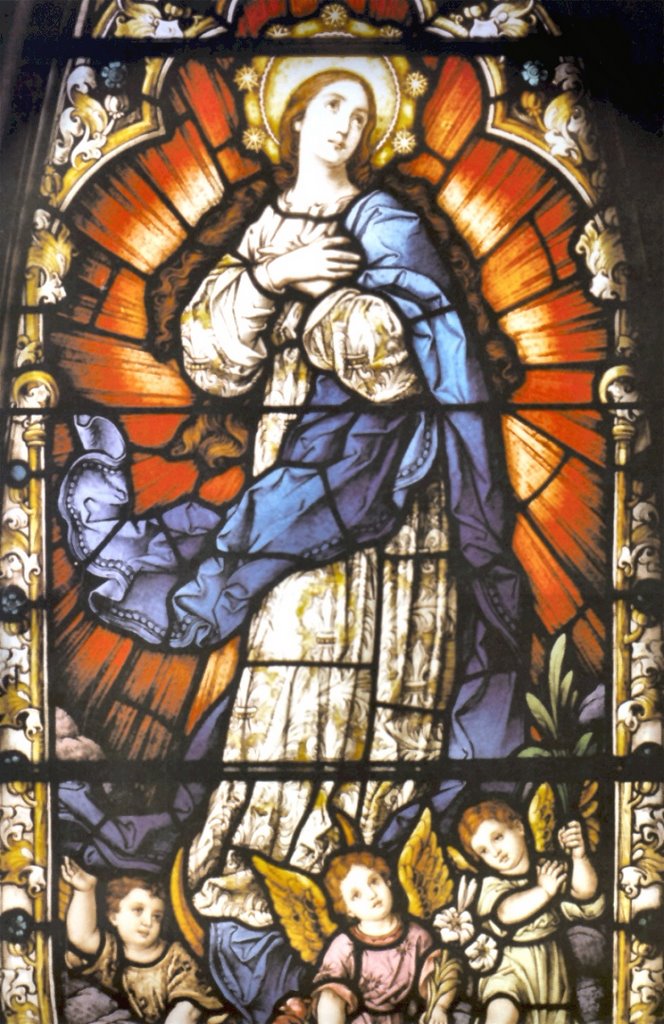
"Be one of the small number who find the way to life, and enter by the narrow gate into Heaven. Take care not to follow the majority and the common herd, so many of whom are lost. Do not be deceived; there are only two roads: one that leads to life and is narrow; the other that leads to death and is wide. There is no middle way."
"The number of the elect is so small - so small - that, were we to know how small it is, we would faint away with grief: one here and there, scattered up and down the world! " - St. Louis De Montfort
"I see around me a multitude of those who, blindly persevering in error, despise the true God; but I am a Christian nevertheless, and I follow the instruction of the Apostles. If this deserves chastisement, reward it; for I am determined to suffer every torture rather then become the slave of the devil. Others may do as they please since they are [...] reckless of the future life which is to be obtained only by sufferings. Scripture tells us that "narrow is the way that leads to life" [...] because it is one of affliction and of persecutions suffered for the sake of justice; but it is wide enough for those who walk upon it, because their faith and the hope of an eternal reward make it so for them. [...] On the contrary, the road of vice is in reality narrow, and it leads to an eternal precipice." - St. Leo of Patara
"The majority of men shall not see God, excepting those who live justly, purified by righteousness and by every other virtue." - St. Justin the Martyr
"Nor should we think that it is enough for salvation that we are no worse off than the mass of the careless and indifferent, or that in our faith we are, like so many others, uninstructed." - St. Bede the Venerable
"If you want to be certain of being in the number of the Elect, strive to be one of the few, not one of the many. And if you would be quite sure of your salvation, strive to be among the fewest of the few; that is to say, do not follow the great majority of mankind, but follow those who enter upon the narrow way, who renounce the world, who give themselves to prayer, and who never relax their efforts by day or night, so that they may attain everlasting blessedness. " - St. Anselm
"If you wish to imitate the multitude, then you shall not be among the few who shall enter in by the narrow gate." - St. Augustine
"So that you will better appreciate the meaning of Our Lord's words, and perceive more clearly how few the Elect are, note that Christ did not say that those who walked in the path to Heaven are few in number, but that there were few who found that narrow way. It is as though the Saviour intended to say: The path leading to Heaven is so narrow and so rough, so overgrown, so dark and difficult to discern, that there are many who never find it their whole life long. And those who do find it are constantly exposed to the danger of deviating from it, of mistaking their way, and unwittingly wandering away from it, because it is so irregular and overgrown." - St. Jerome
"It is granted to few to recognize the true Church amid the darkness of so many schisms and heresies, and to fewer still so to love the truth which they have seen as to fly to its embrace." - St. Robert Bellarmine
"That those who walk in the way of salvation are the smaller number is due to the vice and depraved habits imbibed in youth and nourished in childhood. By these means Lucifer has hurled into Hell so great a number of souls, and continues thus to hurl them into Hell every day, casting so many nations from abyss to abyss of darkness and errors, such as are contained in the heresies and false sects of the infidels." - Ven. Mary of Agreda
"I do not speak rashly, but as I feel and think. I do not think that many priests are saved, but that those who perish are far more numerous." - St. John Chrysostom
"It is as though Jesus said: "O My Father, I am indeed going to clothe myself with human flesh, but the greater part of the world will set no value on my blood!" - St. Isidore of Seville
"Notwithstanding assurances that God did not create any man for Hell, and that He wishes all men to be saved, it remains equally true that only few will be saved; that only few will go to Heaven; and that the greater part of mankind will be lost forever. - St. John Neumann
Showing posts with label EENS. Show all posts
Showing posts with label EENS. Show all posts
Friday, September 21, 2007

Wednesday, September 19, 2007
St. Alphonsus on salvation
"The greater number of men still say to God: Lord we will not serve Thee; we would rather be slaves of the devil, and condemned to Hell, than be Thy servants. Alas! The greatest number, my Jesus - we may say nearly all - not only do not love Thee, but offend Thee and despise Thee. How many countries there are in which there are scarcely any Catholics, and all the rest either infidels or heretics! And all of them are certainly on the way to being lost. "
"The greater part of men choose to be damned rather than to love Almighty God."
"What is the number of those who love Thee, O God? How few they are! The Elect are much fewer than the damned! Alas! The greater portion of mankind lives in sin unto the devil, and not unto Jesus Christ. O Saviour of the world, I thank Thee for having called and permitted us to live in the true faith which the Holy Roman Catholic Church teaches. [...] But alas, O my Jesus! How small is the number of those who live in this holy faith! Oh, God! The greater number of men he buried in the darkness of infidelity and heresy. Thou hast humbled Thyself to death, to the death of the cross, for the salvation of men, and these ungrateful men are unwilling even to know Thee. Ah, I pray Thee, O omnipotent God, O sovereign and infinite Good, make all men know and love Thee!"
"In the Great Deluge in the days of Noah, nearly all mankind perished, eight persons alone being saved in the Ark. In our days a deluge, not of water but of sins, continually inundates the earth, and out of this deluge very few escape. Scarcely anyone is saved."
"We owe God a deep regret of gratitude for the purely gratuitous gift of the true faith with which he has favored us. How many are the infidels, heretics and schismatic who do not enjoy comparable happiness? The earth is full of them and they are all lost!"
“(St.) Robert Bellarmine relates that having gone to assist a certain dying person, and having exhorted him to make an act of contrition, the man replied that he did not know what contrition was. Bellarmine endeavored to explain it to him; but the sick man said: ‘Father, I do not understand you; I am incapable of these things.’ And thus he died, ‘leaving clear signs of his damnation,’ as is recorded in the writings of Bellarmine. The just punishment of the sinner, says St. Augustine, will be, that having forgotten God in his lifetime, he shall forget himself in death.”
"The greater part of men choose to be damned rather than to love Almighty God."
"What is the number of those who love Thee, O God? How few they are! The Elect are much fewer than the damned! Alas! The greater portion of mankind lives in sin unto the devil, and not unto Jesus Christ. O Saviour of the world, I thank Thee for having called and permitted us to live in the true faith which the Holy Roman Catholic Church teaches. [...] But alas, O my Jesus! How small is the number of those who live in this holy faith! Oh, God! The greater number of men he buried in the darkness of infidelity and heresy. Thou hast humbled Thyself to death, to the death of the cross, for the salvation of men, and these ungrateful men are unwilling even to know Thee. Ah, I pray Thee, O omnipotent God, O sovereign and infinite Good, make all men know and love Thee!"
"In the Great Deluge in the days of Noah, nearly all mankind perished, eight persons alone being saved in the Ark. In our days a deluge, not of water but of sins, continually inundates the earth, and out of this deluge very few escape. Scarcely anyone is saved."
"We owe God a deep regret of gratitude for the purely gratuitous gift of the true faith with which he has favored us. How many are the infidels, heretics and schismatic who do not enjoy comparable happiness? The earth is full of them and they are all lost!"
“(St.) Robert Bellarmine relates that having gone to assist a certain dying person, and having exhorted him to make an act of contrition, the man replied that he did not know what contrition was. Bellarmine endeavored to explain it to him; but the sick man said: ‘Father, I do not understand you; I am incapable of these things.’ And thus he died, ‘leaving clear signs of his damnation,’ as is recorded in the writings of Bellarmine. The just punishment of the sinner, says St. Augustine, will be, that having forgotten God in his lifetime, he shall forget himself in death.”
The Fewness of the elect
Most Catholics go to hell
Being Catholic is the first and necessary step toward salvation, but it is not the only one. As a Catholic, your salvation is not guaranteed. Just as good works without the Catholic faith is dead (cannot give you eternal salvation), the Catholic “faith without works is [also] dead.” (James 2:26)
Jesus says that only few men attain eternal salvation. He says, “Enter ye in at the narrow gate… How narrow is the gate, and strait is the way that leadeth to life: and few there are that find it!” (Mt. 7:13-14) These few men are only Catholics. The Athanasian Creed of 361 infallibly teaches that “Whoever wishes to be saved must, above all, keep the Catholic faith.”[1]
But not all Catholics will be saved. Jesus also says that only few Catholics attain eternal salvation. Commanding His disciples to evangelize, He says, “Go ye therefore into the highways; and as many as you shall find, call to the marriage [evangelize]. And his servants going forth into the ways, gathered together all that they found, both bad and good: and the marriage was filled with guests [good and bad Catholics]. And the king went in to see the guests: and he saw there a man who had not on a wedding garment [a bad Catholic]. And he saith to him: Friend, how camest thou in hither not having a wedding garment? But he was silent. Then the king said to the waiters: Bind his hands and feet, and cast him into the exterior darkness [hell]: there shall be weeping and gnashing of teeth. For many are called [Catholics], but few are chosen [saved].” (Mt. 22:9-14) Jesus, speaking of the Catholic congregation at Sardis, says, “Thou hast a few names… which have not defiled their garments: and they shall walk with me in white, because they are worthy.” (Apoc. 3:4) That is why St. Paul tells Catholics to “work out your salvation in fear and trembling,” (Phil. 2:12) and St. Peter says, “If the just man [a good Catholic] shall scarcely be saved, where shall the ungodly and the sinner appear?” (1 Pt. 4:18) St. Leonard of Port Maurice, in his sermon “The Little Number of Those Who Are Saved,” gives a fearful account of how few Catholics are saved. He says, “One day Saint John Chrysostom, preaching in the cathedral in Constantinople and considering these proportions, could not help but shudder in horror and ask, ‘Out of this great number of people, how many do you think will be saved?’ And, not waiting for an answer, he added, ‘Among so many thousands of people, we would not find a hundred who are saved, and I even doubt for the one hundred.’ What a dreadful thing! The great Saint believed that out of so many people, barely one hundred would be saved; and even then, he was not sure of that number. What will happen to you who are listening to me? Great God, I cannot think of it without shuddering! Brothers, the problem of salvation is a very difficult thing; for according to the maxims of the theologians, when an end demands great efforts, few only attain it. That is why Saint Thomas, the Angelic Doctor, after weighing all the reasons pro and con in his immense erudition, finally concludes that the greater number of Catholic adults are damned…
“The following narrative from Saint Vincent Ferrer will show you what you may think about it. He relates that an archdeacon in Lyons gave up his charge and retreated into a desert place to do penance, and that he died the same day and hour as Saint Bernard. After his death, he appeared to his bishop and said to him, ‘Know, Monsignor, that at the very hour I passed away, thirty-three thousand people also died. Out of this number, Bernard and myself went up to heaven without delay, three went to purgatory, and all the others fell into Hell.’”
You should now have an idea of how very, very, very few Catholics attain eternal salvation! This truth ought to rid you of any false confidence and make you aware of the fact that every day you live your salvation is in danger. Dear Catholic, if every day you do not sincerely work, by God’s grace, to obtain salvation, you will lose it. Salvation, then, comes only by faith and persevering labor. Jesus says, “Labour… for that which endureth unto life everlasting.” (Jn. 6:27) St. Paul says, “Labour as a good soldier of Christ Jesus.” (2 Tim. 2:3) “We labour, whether absent or present, to please him.” (2 Cor. 5:9) “Being mindful of the work of your faith and labour and charity: and of the enduring of the hope of our Lord Jesus Christ.” (1 Thess. 1:3) And St. Peter says, “Wherefore, brethren, labour the more, that by good works you may make sure your calling and election. For doing these things, you shall not sin at any time.” (2 Pt. 1:10) From St. Alphonsus Marie de Liguori’s book The Dignity and Duties of Priests, we read, “St. Bernard says that the solicitude of the devils for our destruction should make us solicitous in laboring for salvation.”[2] For Catholics to gain eteral life, St. Paul says they must finish and win the race for the salvation of their immortal souls. He says, “Know you not that they that run in the race, all run indeed, but one receiveth the prize? So run that you may obtain.” (1 Cor. 9:24) The Haydock Commentary on his passage says, “It is true in our case many obtain the crown for which we strive, but every one is in danger of losing it, and so must use all his endeavours to obtain it.”
Being Catholic is the first and necessary step toward salvation, but it is not the only one. As a Catholic, your salvation is not guaranteed. Just as good works without the Catholic faith is dead (cannot give you eternal salvation), the Catholic “faith without works is [also] dead.” (James 2:26)
Jesus says that only few men attain eternal salvation. He says, “Enter ye in at the narrow gate… How narrow is the gate, and strait is the way that leadeth to life: and few there are that find it!” (Mt. 7:13-14) These few men are only Catholics. The Athanasian Creed of 361 infallibly teaches that “Whoever wishes to be saved must, above all, keep the Catholic faith.”[1]
But not all Catholics will be saved. Jesus also says that only few Catholics attain eternal salvation. Commanding His disciples to evangelize, He says, “Go ye therefore into the highways; and as many as you shall find, call to the marriage [evangelize]. And his servants going forth into the ways, gathered together all that they found, both bad and good: and the marriage was filled with guests [good and bad Catholics]. And the king went in to see the guests: and he saw there a man who had not on a wedding garment [a bad Catholic]. And he saith to him: Friend, how camest thou in hither not having a wedding garment? But he was silent. Then the king said to the waiters: Bind his hands and feet, and cast him into the exterior darkness [hell]: there shall be weeping and gnashing of teeth. For many are called [Catholics], but few are chosen [saved].” (Mt. 22:9-14) Jesus, speaking of the Catholic congregation at Sardis, says, “Thou hast a few names… which have not defiled their garments: and they shall walk with me in white, because they are worthy.” (Apoc. 3:4) That is why St. Paul tells Catholics to “work out your salvation in fear and trembling,” (Phil. 2:12) and St. Peter says, “If the just man [a good Catholic] shall scarcely be saved, where shall the ungodly and the sinner appear?” (1 Pt. 4:18) St. Leonard of Port Maurice, in his sermon “The Little Number of Those Who Are Saved,” gives a fearful account of how few Catholics are saved. He says, “One day Saint John Chrysostom, preaching in the cathedral in Constantinople and considering these proportions, could not help but shudder in horror and ask, ‘Out of this great number of people, how many do you think will be saved?’ And, not waiting for an answer, he added, ‘Among so many thousands of people, we would not find a hundred who are saved, and I even doubt for the one hundred.’ What a dreadful thing! The great Saint believed that out of so many people, barely one hundred would be saved; and even then, he was not sure of that number. What will happen to you who are listening to me? Great God, I cannot think of it without shuddering! Brothers, the problem of salvation is a very difficult thing; for according to the maxims of the theologians, when an end demands great efforts, few only attain it. That is why Saint Thomas, the Angelic Doctor, after weighing all the reasons pro and con in his immense erudition, finally concludes that the greater number of Catholic adults are damned…
“The following narrative from Saint Vincent Ferrer will show you what you may think about it. He relates that an archdeacon in Lyons gave up his charge and retreated into a desert place to do penance, and that he died the same day and hour as Saint Bernard. After his death, he appeared to his bishop and said to him, ‘Know, Monsignor, that at the very hour I passed away, thirty-three thousand people also died. Out of this number, Bernard and myself went up to heaven without delay, three went to purgatory, and all the others fell into Hell.’”
You should now have an idea of how very, very, very few Catholics attain eternal salvation! This truth ought to rid you of any false confidence and make you aware of the fact that every day you live your salvation is in danger. Dear Catholic, if every day you do not sincerely work, by God’s grace, to obtain salvation, you will lose it. Salvation, then, comes only by faith and persevering labor. Jesus says, “Labour… for that which endureth unto life everlasting.” (Jn. 6:27) St. Paul says, “Labour as a good soldier of Christ Jesus.” (2 Tim. 2:3) “We labour, whether absent or present, to please him.” (2 Cor. 5:9) “Being mindful of the work of your faith and labour and charity: and of the enduring of the hope of our Lord Jesus Christ.” (1 Thess. 1:3) And St. Peter says, “Wherefore, brethren, labour the more, that by good works you may make sure your calling and election. For doing these things, you shall not sin at any time.” (2 Pt. 1:10) From St. Alphonsus Marie de Liguori’s book The Dignity and Duties of Priests, we read, “St. Bernard says that the solicitude of the devils for our destruction should make us solicitous in laboring for salvation.”[2] For Catholics to gain eteral life, St. Paul says they must finish and win the race for the salvation of their immortal souls. He says, “Know you not that they that run in the race, all run indeed, but one receiveth the prize? So run that you may obtain.” (1 Cor. 9:24) The Haydock Commentary on his passage says, “It is true in our case many obtain the crown for which we strive, but every one is in danger of losing it, and so must use all his endeavours to obtain it.”
Monday, August 13, 2007
Invincible Ignorance Does Not Save
Invincible or Inculpable Ignorance Neither Saves nor Damns a Person
by Father Michael Müller, C.Ss.R.
(excerpted from The Catholic Dogma)
"But, suppose", some one will say, "a person, in his inculpable ignorance, believes that he is on the right road to Heaven, though he is not a Catholic; he tries his best to live up to the dictates of his conscience. Now, should he die in that state of belief, he would, it seems, be condemned without his fault. We can understand that God is not bound to give Heaven to anybody, but, as He is just, He certainly cannot condemn anybody without his fault."
Whatever question may be made still in regard to the great truth, in question is sufficiently answered in the explanation already given of this great truth4. For the sake of greater clearness, however, we will answer a few more questions. In the answers to these questions we shall be obliged to repeat what has already been said.
Now, as to the question just proposed, we answer with St. Thomas and St. Augustine: "There are many things which a man is obliged to do, but which he cannot do without the help of divine grace: as, for instance, to love God and his neighbor, and to believe the articles of faith; but he can do all this with the help of grace; and 'to whomsoever God gives His grace He gives it out of Divine Mercy: and to whomsoever He does not give it, He refuses it out of divine justice, in punishment of sin committed, or at least in punishment of original sin," as St. Augustine says. (Lib. de correptione et gratia, c. 5 et 6; Sum. 22. q. ii art. v.) "And the ignorance of these things of salvation, the knowledge of which men did not care to have, is, without doubt, a sin for them; but for those who were not able to acquire such knowledge, the want of it is a punishment for their sins", says St. Augustine; hence both are justly condemned, and neither the one nor the other has a just excuse for being lost." (Epist. ad Sixtum, Edit. Maur. 194, cap. vi., n. 27.)
Moreover, a person who wants to go east, but, by an innocent mistake, gets on a train going west, will, as soon as he finds out his mistake, get off at the next station, and take a train that goes east. In like manner, a person who walked on a road that he, in his inculpable ignorance, believed was the true road to Heaven, must leave that road, as soon as he finds out his mistake, and inquire for the true road to Heaven. God, in His infinite mercy, will not fail to make him find out, in due time, the true road to Heaven, if he corresponds to His grace. Hence we asked the following question in our Familiar Explanation:
"What are we to think of the salvation of those who are out of the pale of the Church without any fault of theirs, and who never had any opportunity to know better?"
To this question we give the following answer:
"Their inculpable (invincible) ignorance will not save them; but if they fear God and live up to their conscience, God, in His infinite mercy, will furnish them with the necessary means of salvation, even so as to send, if needed, an angel to instruct them in the Catholic Faith, rather than let them perish through inculpable ignorance." (St. Thomas Aquinas)
Liberal Objections
S. O. remarks about this answer, "that the author is not theologically correct, for no one will ever be punished through, by, or because of inculpable ignorance." In these words, S. O. impudently imputes to us what we never have asserted, namely, that a man will be damned on account of his inculpable ignorance. From the fact that a person tries to live up to the dictates of his conscience, and cannot sin against the true religion on account of being invincibly ignorant of it, many have drawn the false conclusion that such a person is saved, or, in other words, is in the state of sanctifying grace, making thus invincible ignorance a means of salvation. This conclusion is contra "latius hos quam permissæ". To give an example. Rev. Nicholas Russo, S. J., professor of philosophy in Boston College, says in his book, The True Religion and its Dogmas:
"This good faith being supposed, we say that such a Christian (he means a baptized Protestant) is in a way a member of the Catholic Church. Ignorance alone is the cause of his not acknowledging the authority of his true mother. The Catholic Church does not look upon him as wholly a stranger; she calls him her child; she presses him to her maternal heart; through other hands she prepares him to shine in the kingdom of Heaven. Yes, the profession of a creed different from the true one will not, of itself, bar the gates of Heaven before this Christian; invincible ignorance will, before the tribunal of the just God, ensure the pardon of his errors against faith; and, if nothing else be wanting, Heaven will be his home for eternity."
We have already sufficiently refuted these false assertions, and we have quoted them, not for the purpose of refuting them, but for the purpose of denying emphatically what follows after these false assertions, namely:
"This is the doctrine held by almost all theologians, and has received the sanction of our late Pope Pius IX. In his allocution of December 9, 1854, we read the following words: 'It is indeed of faith that no one can be saved outside the Apostolic Roman Church; that this Church is the one ark of salvation; that he who has not entered it will perish in the deluge. But, on the other hand, it is equally certain that, were a man to be invincibly ignorant of the true religion, he would not be held guilty in the sight of God for not professing it.' "
The True Teaching of Pius IX
Now, in which of these words of Pope Pius IX is any of the above false assertions of the Rev. N. Russo, S. J., sanctioned? In which words does Pius IX say that a Protestant in good faith is in a way a member of the Catholic Church? Does not Pius IX teach quite the contrary in the following words:
"Now, whoever will carefully examine and reflect upon the condition of the various religious societies, divided among themselves, and separated from the Catholic Church -- which, from the days of Our Lord Jesus Christ and His Apostles, has ever exercised, by its lawful pastors, and still does exercise, the divine power committed to it by this same Lord -- will easily satisfy himself that none of these societies, singly nor all together, are in any way or form that one Catholic Church which our Lord founded and built, and which He chose should be; and that he cannot by any means say that these societies are members or parts of that Church, since they are visibly separate from Catholic unity ...
"Let all those, then, who do not profess the unity and truth of the Catholic Church, avail themselves of the opportunity of this (Vatican) Council, in which the Catholic Church, to which their forefathers belonged, affords a new proof of her close unity and her invincible vitality, and let them satisfy the longings of their hearts, and liberate themselves from that state in which they cannot have any assurance of their own salvation. Let them unceasingly offer fervent prayers to the God of Mercy, that He will throw down the wall of separation, that He will scatter the darkness of error, and that He will lead them back to the Holy Mother Church, in whose bosom their fathers found the salutary pastures of life, in whom alone the whole doctrine of Jesus Christ is preserved and handed down, and the mysteries of heavenly grace dispensed."
Now does not Pius IX say in these words, very plainly and distinctly, that the "members of all other religious societies are visibly separated from Catholic unity; that in this state of separation they cannot have salvation; that, by fervent prayer, they should beseech God to throw down the wall of separation, to scatter the darkness of error, and lead them to the Mother Church, in which alone salvation is found."
And in his Allocution to the Cardinals, held Dec. 17, 1847, Pius IX says: "Let those, therefore, who wish to be saved, come to the pillar and the ground of faith, which is the Church; let them come to the true Church of Christ, which, in her bishops, and in the Roman Pontiff, the Chief Head of all, has the succession of apostolical Authority, which has never been interrupted, which has never counted anything of greater importance than to preach, and by all means to keep and defend the doctrine proclaimed by the Apostles at Christ's command ... We shall never at any time abstain from any cares or labors that, by the grace of Christ Himself, we may bring those who are ignorant, and who are going astray, to THlS ONLY ROAD OF TRUTH and SALVATION.'' Now does not Pius IX teach most clearly in these words that the ignorant cannot be saved by their ignorance, but that, in order to be saved they must come to the only road of truth and salvation, which is the Roman Catholic Church.
Again, does not Pius IX most emphatically declare, in the words quoted above by the Rev. N. Russo, S. J., that "It is indeed of faith, that NO ONE can be saved out of the Apostolic Roman Church?" How, then, we ask, can the Rev. N. Russo, S. J. say in truth, that a Protestant in good faith, such as he described, is in a way a member of the Catholic Church? That the Catholic Church does not look upon him as wholly a stranger? That she calls him her child, presses him to her maternal heart, prepares him, through other hands to shine in the kingdom of God? That the profession of a creed different from the true one will not, of itself, bar the gates of Heaven before this Christian, etc.? How can this professor of philosophy at the Boston College assert all this, whilst Pius IX teaches the very contrary? And mark especially the scandalous assertion of the Rev. N. Russo, S. J., namely: "This our opinion is the doctrine which has received the sanction of our late Pope Pius IX" To prove his scandalous assertion, he quotes the following words of Pius IX: "It is equally certain that, were a man to be invincibly ignorant of the true religion, he would not be held guilty in the sight of God for not professing it."
If, in these words, Pius IX says what no one calls in question, that invincible ignorance of the true religion excuses a Protestant from the sin of heresy, does Pius IX thereby teach that such invincible ignorance saves such a Protestant? Does he teach that invincible ignorance supplies all that is necessary for salvation -- all that you can have only in the true faith? How could the Professor of philosophy at the Jesuit College in Boston draw such a false and scandalous conclusion from premises in which it is not contained?
Pius IX has, on many occasions, condemned such liberal opinions. Read his Allocution to the Cardinals, held Dec. 17, 1847, in which he expresses his indignation against all those who had said that he had sanctioned such perverse opinions. "In our times", says he, "many of the enemies of the Catholic Faith direct their efforts towards placing every monstrous opinion on the same level with the doctrine of Christ, or confounding it therewith; and so they try more and more to propagate that impious system of the indifference of religions. But quite recently -- we shudder to say it certain men have not hesitated to slander us by saying that we share in their folly, favor that most wicked system, and think so benevolently of every class of mankind as to suppose that not only the sons of the Church, but that the rest also, however alienated from Catholic unity they may remain, are alike in the way of salvation, and may arrive at everlasting life. We are at a loss, from horror, to find words to express our detestation of this new and atrocious injustice that is done to us."
Mark well, Pius IX uttered these solemn words against "certain men'', whom he calls the enemies of the Catholic Faith, -- he means liberal minded Catholics and priests, as is evident from other Allocutions, in which he says that he has condemned not less than forty times their perverse opinions about religion. Is it not, for instance, a perverse and monstrous opinion, when the Rev. N. Russo, S. J., says: "The spiritual element (of the Church) comprises all the graces and virtues that are the foundation of the spiritual life; it includes the gifts of the Holy Ghost; in other words, it is what theologians call the soul of the Church. (Now follows the monstrous opinion) This mysterious soul is not limited by the bounds of the exterior organization (of the Church); it can go far beyond; exist even in the midst of schism and heresy unconsciously professed, and bind to our Lord hearts that are connected by no exterior ties with the visible Body of the Church. This union with the soul of the Church is essential to salvation; so essential that without it none can be saved. But the necessity of belonging likewise to the Body of the Church, though a real one, may in certain cases offer no obstacle to salvation. This happens whenever invincible ignorance so shrouds a man's intellectual vision, that he ceases to be responsible before God for the light which he does not see?" The refutation of this monstrous opinion is sufficiently given in all we have said before. The very Allocution of Pius IX, from which the Rev. N. Russo quotes, is a direct condemnation of such monstrous opinions.
Now these modern would-be theologians are not ashamed to assure us most solemnly that their opinions are the doctrine held by almost all theologians, and yet they cannot quote one proof from Holy Scripture, or from the writings of the Fathers and Doctors of the Church, to give the least support to their opinions.
The Rev. N. Russo and S. O. seem not to see the difference between saying: Inculpable ignorance will not save a man, and inculpable ignorance will not damn a man. Each assertion is correct, and yet there is a great difference between the two. It will be an act of charity to enlighten them on the point in question.
Neither Saves nor Condemns
Inculpable or invincible ignorance has never been and will never be a means of salvation. To be saved, it is necessary to be justified, or to be in the state of sanctifying grace. In order to obtain sanctifying grace, it is necessary to have the proper dispositions for justification; that is, true divine faith in at least the necessary truths of salvation, confident hope in the divine Savior, sincere sorrow for sin, together with the firm purpose of doing all that God has commanded, etc. Now, these supernatural acts of faith, hope, charity, contrition, etc., which prepare the soul for receiving sanctifying grace, can never be supplied by invincible ignorance; and if invincible ignorance cannot supply the preparation for receiving sanctifying grace, much less can it bestow sanctifying grace itself. "Invincible ignorance", says St. Thomas Aquinas, "is a punishment for sin". (De Infid. q. x., art. 1.) It is, then, a curse, but not a blessing or a means of salvation.
But if we say that inculpable ignorance cannot save a man, we thereby do not say that invincible ignorance damns a man. Far from it. To say, invincible ignorance is no means of salvation, is one thing; and to say, invincible ignorance is the cause of damnation, is another. To maintain the latter would be wrong, for inculpable ignorance of the fundamental principles of faith excuses a heathen from the sin of infidelity, and a Protestant from the sin of heresy; because such invincible ignorance, being only a simple involuntary privation, is no sin.
Hence Pius IX said "that, were a man to be invincibly ignorant of the true religion, such invincible ignorance would not be sinful before God; that, if such a person should observe the precepts of the Natural Law and do the will of God to the best of his knowledge, God, in His infinite mercy, may enlighten him so as to obtain eternal life; for, the Lord, who knows the heart and thoughts of man, will, in His infinite goodness, not suffer any one to be lost forever without his own fault."
by Father Michael Müller, C.Ss.R.
(excerpted from The Catholic Dogma)
"But, suppose", some one will say, "a person, in his inculpable ignorance, believes that he is on the right road to Heaven, though he is not a Catholic; he tries his best to live up to the dictates of his conscience. Now, should he die in that state of belief, he would, it seems, be condemned without his fault. We can understand that God is not bound to give Heaven to anybody, but, as He is just, He certainly cannot condemn anybody without his fault."
Whatever question may be made still in regard to the great truth, in question is sufficiently answered in the explanation already given of this great truth4. For the sake of greater clearness, however, we will answer a few more questions. In the answers to these questions we shall be obliged to repeat what has already been said.
Now, as to the question just proposed, we answer with St. Thomas and St. Augustine: "There are many things which a man is obliged to do, but which he cannot do without the help of divine grace: as, for instance, to love God and his neighbor, and to believe the articles of faith; but he can do all this with the help of grace; and 'to whomsoever God gives His grace He gives it out of Divine Mercy: and to whomsoever He does not give it, He refuses it out of divine justice, in punishment of sin committed, or at least in punishment of original sin," as St. Augustine says. (Lib. de correptione et gratia, c. 5 et 6; Sum. 22. q. ii art. v.) "And the ignorance of these things of salvation, the knowledge of which men did not care to have, is, without doubt, a sin for them; but for those who were not able to acquire such knowledge, the want of it is a punishment for their sins", says St. Augustine; hence both are justly condemned, and neither the one nor the other has a just excuse for being lost." (Epist. ad Sixtum, Edit. Maur. 194, cap. vi., n. 27.)
Moreover, a person who wants to go east, but, by an innocent mistake, gets on a train going west, will, as soon as he finds out his mistake, get off at the next station, and take a train that goes east. In like manner, a person who walked on a road that he, in his inculpable ignorance, believed was the true road to Heaven, must leave that road, as soon as he finds out his mistake, and inquire for the true road to Heaven. God, in His infinite mercy, will not fail to make him find out, in due time, the true road to Heaven, if he corresponds to His grace. Hence we asked the following question in our Familiar Explanation:
"What are we to think of the salvation of those who are out of the pale of the Church without any fault of theirs, and who never had any opportunity to know better?"
To this question we give the following answer:
"Their inculpable (invincible) ignorance will not save them; but if they fear God and live up to their conscience, God, in His infinite mercy, will furnish them with the necessary means of salvation, even so as to send, if needed, an angel to instruct them in the Catholic Faith, rather than let them perish through inculpable ignorance." (St. Thomas Aquinas)
Liberal Objections
S. O. remarks about this answer, "that the author is not theologically correct, for no one will ever be punished through, by, or because of inculpable ignorance." In these words, S. O. impudently imputes to us what we never have asserted, namely, that a man will be damned on account of his inculpable ignorance. From the fact that a person tries to live up to the dictates of his conscience, and cannot sin against the true religion on account of being invincibly ignorant of it, many have drawn the false conclusion that such a person is saved, or, in other words, is in the state of sanctifying grace, making thus invincible ignorance a means of salvation. This conclusion is contra "latius hos quam permissæ". To give an example. Rev. Nicholas Russo, S. J., professor of philosophy in Boston College, says in his book, The True Religion and its Dogmas:
"This good faith being supposed, we say that such a Christian (he means a baptized Protestant) is in a way a member of the Catholic Church. Ignorance alone is the cause of his not acknowledging the authority of his true mother. The Catholic Church does not look upon him as wholly a stranger; she calls him her child; she presses him to her maternal heart; through other hands she prepares him to shine in the kingdom of Heaven. Yes, the profession of a creed different from the true one will not, of itself, bar the gates of Heaven before this Christian; invincible ignorance will, before the tribunal of the just God, ensure the pardon of his errors against faith; and, if nothing else be wanting, Heaven will be his home for eternity."
We have already sufficiently refuted these false assertions, and we have quoted them, not for the purpose of refuting them, but for the purpose of denying emphatically what follows after these false assertions, namely:
"This is the doctrine held by almost all theologians, and has received the sanction of our late Pope Pius IX. In his allocution of December 9, 1854, we read the following words: 'It is indeed of faith that no one can be saved outside the Apostolic Roman Church; that this Church is the one ark of salvation; that he who has not entered it will perish in the deluge. But, on the other hand, it is equally certain that, were a man to be invincibly ignorant of the true religion, he would not be held guilty in the sight of God for not professing it.' "
The True Teaching of Pius IX
Now, in which of these words of Pope Pius IX is any of the above false assertions of the Rev. N. Russo, S. J., sanctioned? In which words does Pius IX say that a Protestant in good faith is in a way a member of the Catholic Church? Does not Pius IX teach quite the contrary in the following words:
"Now, whoever will carefully examine and reflect upon the condition of the various religious societies, divided among themselves, and separated from the Catholic Church -- which, from the days of Our Lord Jesus Christ and His Apostles, has ever exercised, by its lawful pastors, and still does exercise, the divine power committed to it by this same Lord -- will easily satisfy himself that none of these societies, singly nor all together, are in any way or form that one Catholic Church which our Lord founded and built, and which He chose should be; and that he cannot by any means say that these societies are members or parts of that Church, since they are visibly separate from Catholic unity ...
"Let all those, then, who do not profess the unity and truth of the Catholic Church, avail themselves of the opportunity of this (Vatican) Council, in which the Catholic Church, to which their forefathers belonged, affords a new proof of her close unity and her invincible vitality, and let them satisfy the longings of their hearts, and liberate themselves from that state in which they cannot have any assurance of their own salvation. Let them unceasingly offer fervent prayers to the God of Mercy, that He will throw down the wall of separation, that He will scatter the darkness of error, and that He will lead them back to the Holy Mother Church, in whose bosom their fathers found the salutary pastures of life, in whom alone the whole doctrine of Jesus Christ is preserved and handed down, and the mysteries of heavenly grace dispensed."
Now does not Pius IX say in these words, very plainly and distinctly, that the "members of all other religious societies are visibly separated from Catholic unity; that in this state of separation they cannot have salvation; that, by fervent prayer, they should beseech God to throw down the wall of separation, to scatter the darkness of error, and lead them to the Mother Church, in which alone salvation is found."
And in his Allocution to the Cardinals, held Dec. 17, 1847, Pius IX says: "Let those, therefore, who wish to be saved, come to the pillar and the ground of faith, which is the Church; let them come to the true Church of Christ, which, in her bishops, and in the Roman Pontiff, the Chief Head of all, has the succession of apostolical Authority, which has never been interrupted, which has never counted anything of greater importance than to preach, and by all means to keep and defend the doctrine proclaimed by the Apostles at Christ's command ... We shall never at any time abstain from any cares or labors that, by the grace of Christ Himself, we may bring those who are ignorant, and who are going astray, to THlS ONLY ROAD OF TRUTH and SALVATION.'' Now does not Pius IX teach most clearly in these words that the ignorant cannot be saved by their ignorance, but that, in order to be saved they must come to the only road of truth and salvation, which is the Roman Catholic Church.
Again, does not Pius IX most emphatically declare, in the words quoted above by the Rev. N. Russo, S. J., that "It is indeed of faith, that NO ONE can be saved out of the Apostolic Roman Church?" How, then, we ask, can the Rev. N. Russo, S. J. say in truth, that a Protestant in good faith, such as he described, is in a way a member of the Catholic Church? That the Catholic Church does not look upon him as wholly a stranger? That she calls him her child, presses him to her maternal heart, prepares him, through other hands to shine in the kingdom of God? That the profession of a creed different from the true one will not, of itself, bar the gates of Heaven before this Christian, etc.? How can this professor of philosophy at the Boston College assert all this, whilst Pius IX teaches the very contrary? And mark especially the scandalous assertion of the Rev. N. Russo, S. J., namely: "This our opinion is the doctrine which has received the sanction of our late Pope Pius IX" To prove his scandalous assertion, he quotes the following words of Pius IX: "It is equally certain that, were a man to be invincibly ignorant of the true religion, he would not be held guilty in the sight of God for not professing it."
If, in these words, Pius IX says what no one calls in question, that invincible ignorance of the true religion excuses a Protestant from the sin of heresy, does Pius IX thereby teach that such invincible ignorance saves such a Protestant? Does he teach that invincible ignorance supplies all that is necessary for salvation -- all that you can have only in the true faith? How could the Professor of philosophy at the Jesuit College in Boston draw such a false and scandalous conclusion from premises in which it is not contained?
Pius IX has, on many occasions, condemned such liberal opinions. Read his Allocution to the Cardinals, held Dec. 17, 1847, in which he expresses his indignation against all those who had said that he had sanctioned such perverse opinions. "In our times", says he, "many of the enemies of the Catholic Faith direct their efforts towards placing every monstrous opinion on the same level with the doctrine of Christ, or confounding it therewith; and so they try more and more to propagate that impious system of the indifference of religions. But quite recently -- we shudder to say it certain men have not hesitated to slander us by saying that we share in their folly, favor that most wicked system, and think so benevolently of every class of mankind as to suppose that not only the sons of the Church, but that the rest also, however alienated from Catholic unity they may remain, are alike in the way of salvation, and may arrive at everlasting life. We are at a loss, from horror, to find words to express our detestation of this new and atrocious injustice that is done to us."
Mark well, Pius IX uttered these solemn words against "certain men'', whom he calls the enemies of the Catholic Faith, -- he means liberal minded Catholics and priests, as is evident from other Allocutions, in which he says that he has condemned not less than forty times their perverse opinions about religion. Is it not, for instance, a perverse and monstrous opinion, when the Rev. N. Russo, S. J., says: "The spiritual element (of the Church) comprises all the graces and virtues that are the foundation of the spiritual life; it includes the gifts of the Holy Ghost; in other words, it is what theologians call the soul of the Church. (Now follows the monstrous opinion) This mysterious soul is not limited by the bounds of the exterior organization (of the Church); it can go far beyond; exist even in the midst of schism and heresy unconsciously professed, and bind to our Lord hearts that are connected by no exterior ties with the visible Body of the Church. This union with the soul of the Church is essential to salvation; so essential that without it none can be saved. But the necessity of belonging likewise to the Body of the Church, though a real one, may in certain cases offer no obstacle to salvation. This happens whenever invincible ignorance so shrouds a man's intellectual vision, that he ceases to be responsible before God for the light which he does not see?" The refutation of this monstrous opinion is sufficiently given in all we have said before. The very Allocution of Pius IX, from which the Rev. N. Russo quotes, is a direct condemnation of such monstrous opinions.
Now these modern would-be theologians are not ashamed to assure us most solemnly that their opinions are the doctrine held by almost all theologians, and yet they cannot quote one proof from Holy Scripture, or from the writings of the Fathers and Doctors of the Church, to give the least support to their opinions.
The Rev. N. Russo and S. O. seem not to see the difference between saying: Inculpable ignorance will not save a man, and inculpable ignorance will not damn a man. Each assertion is correct, and yet there is a great difference between the two. It will be an act of charity to enlighten them on the point in question.
Neither Saves nor Condemns
Inculpable or invincible ignorance has never been and will never be a means of salvation. To be saved, it is necessary to be justified, or to be in the state of sanctifying grace. In order to obtain sanctifying grace, it is necessary to have the proper dispositions for justification; that is, true divine faith in at least the necessary truths of salvation, confident hope in the divine Savior, sincere sorrow for sin, together with the firm purpose of doing all that God has commanded, etc. Now, these supernatural acts of faith, hope, charity, contrition, etc., which prepare the soul for receiving sanctifying grace, can never be supplied by invincible ignorance; and if invincible ignorance cannot supply the preparation for receiving sanctifying grace, much less can it bestow sanctifying grace itself. "Invincible ignorance", says St. Thomas Aquinas, "is a punishment for sin". (De Infid. q. x., art. 1.) It is, then, a curse, but not a blessing or a means of salvation.
But if we say that inculpable ignorance cannot save a man, we thereby do not say that invincible ignorance damns a man. Far from it. To say, invincible ignorance is no means of salvation, is one thing; and to say, invincible ignorance is the cause of damnation, is another. To maintain the latter would be wrong, for inculpable ignorance of the fundamental principles of faith excuses a heathen from the sin of infidelity, and a Protestant from the sin of heresy; because such invincible ignorance, being only a simple involuntary privation, is no sin.
Hence Pius IX said "that, were a man to be invincibly ignorant of the true religion, such invincible ignorance would not be sinful before God; that, if such a person should observe the precepts of the Natural Law and do the will of God to the best of his knowledge, God, in His infinite mercy, may enlighten him so as to obtain eternal life; for, the Lord, who knows the heart and thoughts of man, will, in His infinite goodness, not suffer any one to be lost forever without his own fault."
Wednesday, June 20, 2007
The One True Church
Here is an elaboration of one idea that I had in my post one Lord One Faith, One Baptism, That there is only One true Church of the Faithful. Here, in this post found on this blog there is a wonderful post on this topic, mainly geared towards Protestants, it focuses on the fact that there is one True Church, and Our Lord did intend his words to be taken literally when addressing the sacrament of the blessed Eucharist. I think it to be a wonderful post and a very well written one at that, as it shows what happens when each man is given freedom to invent his own religion tailored to his likeing, as the Protestants do, who have over 33,000 different denominations and counting. He states very well that there is only one True Church, and that is the Catholic Church.
Pope Leo XIII, Tametsi Futura Prospicientibus, #10: "We would remind those persons of this truth who desire a kind of Christianity such as they themselves have devised, whose precepts should be very mild, much more indulgent towards human nature, and requiring little if any hardships to be borne. They do not properly under stand the meaning of faith and Christian precepts. They do not see that the Cross meets us everywhere, the model of our life, the eternal standard of all who wish to follow Christ in reality and not merely in name."
Subscribe to:
Comments (Atom)