Today is the anniversary of the election of Pope Pius IX to the Chair of St. Peter, as the Pope of the Roman Catholic Church.
Giovanni Maria Mastai-Ferretti was born in Senigallia among a noble family of Girolamo dei conti Ferretti on May 13, 1792.
He received his education at the Piarist College of Volterra and in Rome, where he studied philosophy and theology. He was ordained as a priest of the Roman Catholic Church on April 10, 1819. On May 21, 1827, Pope Leo XII made Fr. Ferretti the Archbishop of Spoleto and on February 17, 1832, Pope Gregory XVI had the Archbishop transferred to the Diocese of Imola, where he was made Cardinal priest on December 14, 1840.
Two weeks after Pope Gregory XVI passed away, June 14, 1846, the conclave for a new pope was assembled. Archbishop Ferretti was elected Pope on the fourth ballot, on June 16, 1846, and took the name of Pius IX in honor of his former benefactor, Pius VII, and was crowned on June 21, 1846.
His first political act, on July 16, was that of granting an amnesty of political prisoners, which was contested by some who now denounced the new pope as one working with the Freemasons.
On November 9, 1846, Pope Pius IX promulgated his encyclical Qui Pluribus in which he laments the conspires of secret societies, the Bible associations, indifferentism, communism, false philosophy, and the licentious press.
On April 19, 1847, he announced a proposed lay advisory council, followed by the establishment of a civic guard on July 5, and on Dec. 29, a cabinet council. Meanwhile, in Rome, the Circolo Romano antagonized an unruly mob against Austria, against which they declared war. On Feb. 8, 1848 a riot forced the Pope to grant a constitution; however, he proclaimed that as the Pope, he could never declare war on Catholic Austria. Nevertheless, the Pope was denounced as a traitor and his Prime Minister Rossi was killed, a papal prelate was shot while standing at a window, and the Pope was attacked in the Quirinal and was forced to promise a democratic ministry. The pope escaped the Quirinal in disguise with the help of Count Spaur and Duc d'Harcourt, the Bavarian and French ambassadors, on Nov. 24, and fled to Gaëta. Rome was now under the power of this radical group who abolished the Papal States and Papal temporal power along with numberless other outrages, and declared a democratic republic, under which the people were oppressed and terrorized. The Pope appealed to Spain, Naples, France, and Austria, and on June 29, French troops restored order in Rome under General Oudinot, and on April 12, 1850, the Pope returned to Rome.
In 1858 Cavour and Napoleon III met in Plombieres plotting war against Austria and the expansion of the Sardinian Kingdom. The dissolution of the Papal states began with the defeat of Austrian forces at Magenta on July 4, 1859 and the subsequent withdrawal of Austrian forces from Papal legations. Victor Emmanuel demanded the annexation of Umbria and the Marches on Feb. 6, 1860. On Sept. 18, he defeated the Papal army at Castelfidardo, and on sept. 30, at ancona, depriving the Pope of almost all of his papal possession, for a time, with the exception of Rome, until when a year later he moved on Rome, making it the capital of the United Italy, completing the disposession of the Papal States. But this was not all that the temporal governments did to suppress the Church. In many countries tithes were abrogated, catholic education was secularized, monasteries were suppressed, Church Property was confiscated, religious orders expelled, and opposing bishops imprisoned or exiled. Such infringements on the rights of the Church were almost universal at this time, most governments of Europe proceeded to seize Church activities as its own. Forbidden to travel from Rome, Pope Pius IX has been considered "the prisoner of the Vatican". The Pope condemned anti-ecclesiastical legislation of Mexico, Columbia, Spain, Austria, Italy, Portugal, Germany, Switzerland, Poland, Prussia, and Russia.
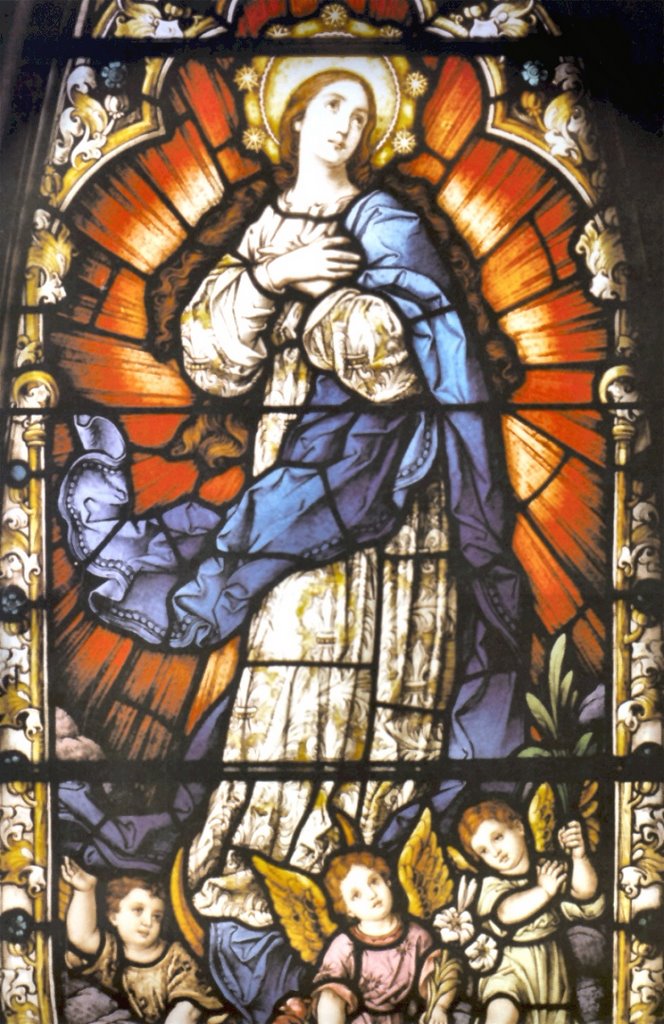
On December 8, 1854 the Pope defined the dogma of the Immaculate Conception of the Blessed Virgin Mary in the Basilica of Saint Peter's before one hundred and seventy bishops and numberless pilgrims coming from all over.
In December of 1864 he promulgated the encyclical Quanta Cura, in which he condemned sixteen errors rampant in 19th century thought. Also at that time he produced the Syllabus Errorum, in which he condemned eighty errors in intellectual thought, including pantheism, naturalism, indifferentism, freemasonry, rationalism, socialism, communism, and religious freedom.
Pope Pius IX, promulgated the papal Bull, Aeterni Patris on June 29, 1869, calling for an ecumenical Council of the Church to be held at the Vatican on Dec. 8, 1869, during which the dogma of Papal infallibility was declared as de fide, a dogma of the Catholic Church.
Pope Pius IX, died on Feb. 7, 1878, and was the longest reigning Pope in the History of the Church, reigning 31 years as the successor of St. Peter.
Pope Pius IX's Links:
Wikipedia on Pope Pius IX
New Advent Catholic Encyclopedia on Pius IX
David Hobson's Heroic Life of His Holines Pope Pius IX
Patron Saints Index on Pius IX
L'Osservatore Romano on Pope Pius IX
Pius IX (Giovanni Maria Mastai-Ferretti, 1792-1878)
Papal Encyclicals of Pope Pius IX
Documents of the First Vatican Council
Pope Pius IX Declares the Immaculate Conception of Mary