Michael Davies (March 13, 1936 - Sept. 25, 2004) was an English Author, teacher, and international lecturer, authoring seventeen books concerning the liturgy, most notable are his triple-volumed sets "The Liturgical Revolution": Cranmer's Godly Order; Pope John's Council; and Pope Paul's New Mass, and "Apologia pro Marcel Lefebvre", and his short work "Liturgical Time Bombs in Vatican II—The Destruction of Catholic Faith Through Changes in Catholic Worship". Born in 1936 and raised in Somerset England, he served in the regular Light Infantry (1954-1960) in the Malayan emergency, Suez Crisis, and the EOKA campaign in Cyprus. A convert to Catholicism in 1956, he taught for three decades in Catholic schools[1] before retiring in 1992. In addition to his published books, he was the author dozens of pamphlets and articles relating to the Catholic Faith and liturgy, and served as president of the International Una Voce Federation for the preservation of the Latin Mass (1995-2003), traveling to Rome & abroad holding discussions with members of the Roman Curia, including the then Josef Cardinal Ratzinger[2]. He died suddenly of a heart attack on September 25, 2004.
______________
Endnotes:
[1] Holding his first teaching position at St. Ignatius Loyola Prep. School, Buckhurst Hill (1964 – 1967), and then in St. Mary’s Primary School, Beckenham, Kent (1967-1994) until retiring.
[2] On October 24, 1998, Cardinal Ratzinger held an audience with about 3,000 indult Catholics from various areas of the globe; Michael Davies represented the English-speaking world.
Thursday, February 28, 2008

Friday, February 15, 2008
An Introduction: Fr. Joaquín Sáenz y Arriaga (1899-1976)
Fr. Joaquín Sáenz y Arriaga, S.J. (Oct. 12, 1899 - April 28, 1976) was a Mexican Doctor of Philosophy, Theology and Canon Law, international author and lecturer, authoring about five dozen books concerning the errors of modernist theology and philosophy which were rampant in the Church of his day, including "The new Montinian Church", "Sede Vacante: Paul VI is not a legitimate Pope", "For Christ and Against Christ," "Apostolate," "The New Mass Is Not the One Catholic Mass" and "Vacant See.". He was ordained to the priesthood a Jesuit, an order which he had joined in 1916 in Barcelona, Spain, and which he would leave 36 years later, on April 30, 1930, celebrating his first mass on May 2nd.
When the changes of Vatican II were administered, he led a resistance to them and promoted what became known as "sedevacantism", that the Roman Catholic Church had been modernized with modernist errors and had been infiltrated by its enemies, that the claimants to the papacy post Pius XII were invalid claimants due to their modernist conduct. As a result of this, in 1972, he was excommunicated by the Roman Catholic bishops' conference of Mexico. Fr. Sáenz died on April 28, 1976, after which his work was continued by Frs. Adolfo Zamora and Moisés Carmona in Mexico and Frs. Francis E. Fenton and Fr. Burton Fraser, S.J. in the United States.
_______________
Related Posts:
When the changes of Vatican II were administered, he led a resistance to them and promoted what became known as "sedevacantism", that the Roman Catholic Church had been modernized with modernist errors and had been infiltrated by its enemies, that the claimants to the papacy post Pius XII were invalid claimants due to their modernist conduct. As a result of this, in 1972, he was excommunicated by the Roman Catholic bishops' conference of Mexico. Fr. Sáenz died on April 28, 1976, after which his work was continued by Frs. Adolfo Zamora and Moisés Carmona in Mexico and Frs. Francis E. Fenton and Fr. Burton Fraser, S.J. in the United States.
_______________
Related Posts:
Monday, January 28, 2008
VITW 2.0
We apologize for the lack of posts here recently at VITW. You may notice that several posts have been pulled from the main page. These have been pulled for editing and revision to improve readability and update them as new information becomes available, or moved to more appropriate pages. Reposts of some of these were intended to be available on New Year's, but things have been more complicated lately, some of us are kind of bogged down with the hectic struggle of having everything working for the holy days, and then taking it all down again, relocating, taking care of newborns, working jobs, education, ect., so we ask that our readers be patient as we work, as much as time allows, towards a few more posts for the '08 edition of Voice in the Wilderness. We're planning to come out with some new articles soon: the Cassiciacum thesis, the conglomeration of similar posts, a series on Lefebvre and the SSPX, and an article describing in-brief the case of Fr. Leonard Feeney and more, plus the above mentioned revisions, hopefully the first of which will be as soon as the second week of February.
Friday, November 30, 2007
An Introduction: Ngô Đình Thục (1897–1984)

Pierre Martin Ngô Đình Thục, was Roman Catholic Archbishop of Huế, Vietnam. He was born in Huế, on October 6, 1897, the eve of the Feast of Our Lady of Victory, in Phu-Cam, Vietnam, Archdiocese of Huế. His family was of some distinguishment, though some of them, later on, met with an undesirable end.[1] Thục became a minor seminarian at age twelve in An Ninh, where he studied for about eight years, and became a major seminarian at the major seminary in Huế, where he studied philosophy. Thục was ordained to the priesthood by the Apostolic Vicar of Huế Bishop Eugène-Marie-Joseph Allys on Dec. 20, 1925, and taught at the Sorbonne in Paris for about a year before he went to Rome to study theology, where he was awared three doctorates, from the Pontifical Gregorian University, in philosophy, theology, and Canon law. He then returned to Vietnam, two years after his ordination, where became a professor at the College of Vietnamese Brothers in Huế, a professor at the major seminary in Huế, and Dean of the College of Providence.
On January 8, 1938, Fr. Thục was chosen by Pope Pius XI to direct the Apostolic Vicariate at Vinh Long and act as bishop. His Holiness sent, as his emissary, Archbishop Antonio Fernand Drapier, Apostolic Delegate to Indochina, to consecrate Thuc as Bishop for this position[2], in which Thục may have also been delegated special faculties to consecrate bishops without a mandate[3]. Nineteen years later, Bishop Thục founded the Dalat University and in 1960, Thục was delegated, by John XXIII, successor to Archbishop Jean-Baptiste Urrutia, who resigned his post after dozen years, as Archbishop of Huế. After the Council, Archbishop Thục was not allowed to return to Vietnam and thus began his life in exile, first in Rome, then on in Toulon, France.[4]
Five years after the Palmar de Troya incidents, May 7, 1981, Bishop Thục consecrated Fr. Michel Louis Guerard des Lauriers, O.P. a principle theologian and author of the Ottaviani Intervention. Later on that year, october 17, while in Munich, Germany, bishop Thục consecrated Fathers Moises Carmona, and Adolfo Zamora from Mexico.
About a year later, Thục conditionally consecrated the former Old Catholic bishop, Christian Datessen. Earlier that year[1982], Thục issued a declaration pronouncing his sedevacantism, after which he departed Germany for the United States at the invitation of Bp. Louis Vezelis O.F.M., a Franciscan former missionary priest, who was consecrated in the Thục line, with whom he took up residence.[5] Archbishop Thục then fell into the hands of a group of Vietnamese priests, while in New York, and was taken to a Vietnamese Roman Catholic monastery [the Vietnamese American religious Congregation of the Mother Co-Redemptrix] in Missouri, where he was inaccessible, and eventually died, for an uncertain reason, perhaps, on December 13, 1984.
________________
End Notes:
[1] His brother, Ngô Đình Diệm, was the first president of South Vietnam, and was later assassinated on Nov. 1, 1963, his nephew was Cardinal François Xavier Nguyễn Văn Thuận; Thục's brother, Ngô Ðình Khôi, was buried alive for refusing to be minister in the communist regime. Thục's other brothers Ngô Đình Nhu and Ngô Đình Cẩn were assassinated as well. Thục and Luyen were the only members of the family who escaped assassination, Luyen by serving as ambassador in London, and Thục was in Rome for the second Vatican Council.
[2] After Archbishop Drapier had consecrated Thục, he [Drapier] neglected to consecrate the other candidates as bishops and thus appointed Thục to do so. Philippe Nguyen-Kim-Dien was among those candidates whom Thục, in turn, consecrated as Bishop of Can-Tho right after his own consecration, and who acted as Thục's successor as Archbishop of Hue; he [Nguyen-Kim-Dien] is also thought to have been a Communist sympathizer.
[3] It is believed that when in Rome, Thục had a private audience with His Holiness Pius XI and obtained from him, and some years later again from Pius XII, an apostolic mandate to consecrate bishops in times of dire necessity when communications would be nearly impossible or the flock in danger. This is recorded in the Dec. issue of the"The Seraph" in 1983 where is written his advice to the Vietnamese bishops, whom he had consecrated, of what to do if ever the Communists took power, "not to publish the names of newly ordained priests; request from the Holy See the faculty for each Bishop to name one or two successors without having to request authorization from the Holy See in case of breakdown of communication with the Vatican." Pope Pius XI is supposed to have granted Thục a motu proprio stating "'In virtue of the fullness of powers of the Holy Apostolic See, we institute as our legate Pierre Martin Ngô-Dinh-Thục, titular Bishop of Saigon, for purposes known to us, with all the powers required.' Given at Rome, near Saint Peter, on March 15, 1938, in the seventeenth year of our pontificate."
[4] According to the logs, Archbishop Thục was Archbishop of Huế from 1960 to 1968 when he was forced to resign by Paul VI. Thục recorded "Paul VI had bad feelings toward my family, and especially towards myself going to the extent of even imposing my resignation as archbishop before the fixed age for the age for retirement of bishops. In my stead, he named one of his favorites imbued with the political philosophy of 'opening to the East.'"
[5] Bp. Vezelis operates a friary in Rochester, NY, where Thục resided from December 1982 until January 1984.
[P. S.] Thục was the principal consecrator of Bishops Antoine Nguyên Van Thien (born 1906) and Michel Nguyên Khác Ngu (born 1909), the oldest living Catholic bishops in Vietnam.
________________
Related Posts:
- An Interview with Fr. Neil Webster on the Last Days of Bishop Thục by MHFM
- Bishop Louis Responds: His story of how it all happened - on the last days of Bishop Thục.
External Links:
- Abp. Thục: A Brief Defense by Bp. Daniel Dolan
- The Validity of the Thục Consecrations by Fr. Anthony Cekada
- Declaration of Archbishop Thục
- Pierre Martin Ngo Dinh Thuc Wikipedia article
Tuesday, November 13, 2007
The Oath Against Modernism
Given by His Holiness St. Pius X September 1, 1910. To be sworn to by all clergy, pastors, confessors, preachers, religious superiors, and professors in philosophical-theological seminaries.
I . . . . firmly embrace and accept each and every definition that has been set forth and declared by the unerring teaching authority of the Church, especially those principal truths which are directly opposed to the errors of this day. And first of all, I profess that God, the origin and end of all things, can be known with certainty by the natural light of reason from the created world (see Rom. 1:90), that is, from the visible works of creation, as a cause from its effects, and that, therefore, his existence can also be demonstrated: Secondly, I accept and acknowledge the external proofs of revelation, that is, divine acts and especially miracles and prophecies as the surest signs of the divine origin of the Christian religion and I hold that these same proofs are well adapted to the understanding of all eras and all men, even of this time. Thirdly, I believe with equally firm faith that the Church, the guardian and teacher of the revealed word, was personally instituted by the real and historical Christ when he lived among us, and that the Church was built upon Peter, the prince of the apostolic hierarchy, and his successors for the duration of time. Fourthly, I sincerely hold that the doctrine of faith was handed down to us from the apostles through the orthodox Fathers in exactly the same meaning and always in the same purport. Therefore, I entirely reject the heretical' misrepresentation that dogmas evolve and change from one meaning to another different from the one which the Church held previously. I also condemn every error according to which, in place of the divine deposit which has been given to the spouse of Christ to be carefully guarded by her, there is put a philosophical figment or product of a human conscience that has gradually been developed by human effort and will continue to develop indefinitely. Fifthly, I hold with certainty and sincerely confess that faith is not a blind sentiment of religion welling up from the depths of the subconscious under the impulse of the heart and the motion of a will trained to morality; but faith is a genuine assent of the intellect to truth received by hearing from an external source. By this assent, because of the authority of the supremely truthful God, we believe to be true that which has been revealed and attested to by a personal God, our creator and lord.
Furthermore, with due reverence, I submit and adhere with my whole heart to the condemnations, declarations, and all the prescripts contained in the encyclical Pascendi and in the decree Lamentabili, especially those concerning what is known as the history of dogmas. I also reject the error of those who say that the faith held by the Church can contradict history, and that Catholic dogmas, in the sense in which they are now understood, are irreconcilable with a more realistic view of the origins of the Christian religion. I also condemn and reject the opinion of those who say that a well-educated Christian assumes a dual personality-that of a believer and at the same time of a historian, as if it were permissible for a historian to hold things that contradict the faith of the believer, or to establish premises which, provided there be no direct denial of dogmas, would lead to the conclusion that dogmas are either false or doubtful. Likewise, I reject that method of judging and interpreting Sacred Scripture which, departing from the tradition of the Church, the analogy of faith, and the norms of the Apostolic See, embraces the misrepresentations of the rationalists and with no prudence or restraint adopts textual criticism as the one and supreme norm. Furthermore, I reject the opinion of those who hold that a professor lecturing or writing on a historico-theological subject should first put aside any preconceived opinion about the supernatural origin of Catholic tradition or about the divine promise of help to preserve all revealed truth forever; and that they should then interpret the writings of each of the Fathers solely by scientific principles, excluding all sacred authority, and with the same liberty of judgment that is common in the investigation of all ordinary historical documents.
Finally, I declare that I am completely opposed to the error of the modernists who hold that there is nothing divine in sacred tradition; or what is far worse, say that there is, but in a pantheistic sense, with the result that there would remain nothing but this plain simple fact-one to be put on a par with the ordinary facts of history-the fact, namely, that a group of men by their own labor, skill, and talent have continued through subsequent ages a school begun by Christ and his apostles. I firmly hold, then, and shall hold to my dying breath the belief of the Fathers in the charism of truth, which certainly is, was, and always will be in the succession of the episcopacy from the apostles. The purpose of this is, then, not that dogma may be tailored according to what seems better and more suited to the culture of each age; rather, that the absolute and immutable truth preached by the apostles from the beginning may never be believed to be different, may never be understood in any other way.
I promise that I shall keep all these articles faithfully, entirely, and sincerely, and guard them inviolate, in no way deviating from them in teaching or in any way in word or in writing. Thus I promise, this I swear, so help me God. . .
Thursday, October 11, 2007
A reader comments on the Links Policy
Regarding a recent Comment:
Anonymous said:
We don't always distance ourselves from linked material, but simply expound that we are not responsible for their material, because we have no control over it, and secondly, we post a disclaimer to illustrate this, and also the fact that we do not regularly read all of the linked sites, that's over a hundred links, and a lot of material, material that I know that I do not have time always to screen, so I advise readers to be prudent; it's why I say "viewer discretion is advised".
We set them because of the reasons mentioned above. It is where there are sometimes some information that is relevant to Traditional Catholicism, but is not always the case, though we do try to moderate them as best as we have time, clearly because most of us here run more than one blog, which we have to keep track of, regular readers may have noticed that such has been done, and is also the reason why we do ask readers to inform us of the status of a link linked from this web log, sometimes they go dead or something worse happens. I'll expand on the issue of links to other blogs some time in the future.
Well, we don't just link sites that agree with us, many are posted that some of us at VITW vehemently disagree with, and some that we do agree with, but our personal opinions are not what are always posted here, mainly, the doctrines, histories, morals, and contentions of Traditional Catholicism. One may notice that we have links from one extreme end of the spectrum and then from the other end of that same spectrum, but are present to demonstrate that spectrum, and to provide witness to some of their contentions and some of the views are espoused by some Traditionals, however, we do try to keep the links relative. Thank you for your interest and your thoughts,
Leo
Anonymous said:
"Even though you provide the links and (as other bloggers have stated) it is up to the individual to ascertain its relevance and whether the content is Catholic, why have this type of stuff? My question is, what is the purpose of providing "linked" material? I might add that it seems bloggers get caught up in the "newness or fun" of putting info out there and just get giddy, posting all sorts of stuff. They distance themselves from linked material, however,just as you outline, however, one can not escape even the slightest degree of connection or association with unacceptable and inappropriate information.First off, I prefer that commenters give themselves some sort of a name, whereby they can be addressed more conveniently, even if it is just one alphabetic letter, please identify. Second: Links are posted that might have some material on that site that might have some relevance, at least, to Traditional Roman Catholicism, usually, this is done via the interesting posts from other sites section, where certain topics of interest bearing relevance to some topic of Traditional Catholicism is posted, those can be so targeted, they are the ones that the reader is directed to because they illustrate one or more points or contentions of one or more perspectives of one or more factions within the traditional Catholic movement. We sometimes post other links, such as to other blogs, other blogs that might be considered Traditional Catholic, or just plain Catholic, or who frequently posts posts that bear relevance toward the same. They are posted so to catalog certain opinions that some people have regarding Traditional Catholicism, not because we agree with them.
You might ask - how did I participate in this endeavor - I got there by YOUR link.
We don't always distance ourselves from linked material, but simply expound that we are not responsible for their material, because we have no control over it, and secondly, we post a disclaimer to illustrate this, and also the fact that we do not regularly read all of the linked sites, that's over a hundred links, and a lot of material, material that I know that I do not have time always to screen, so I advise readers to be prudent; it's why I say "viewer discretion is advised".
I offer this only as a constructive comment. Personally, you are a dedicated and informed writer.
You set blogging rules - why not set rules of engagement? There are links you provide that take a person to novus ordo, counterfeit church sites. Is that where you want readers to go? I have a suggestion. Have no "blog" links and only provide links that pertain to your objective. Christ's Church is currently diminished, would you not agree? But She exists still. Help Her shine for all mankind. Appreciating your hard work, Thanks
We set them because of the reasons mentioned above. It is where there are sometimes some information that is relevant to Traditional Catholicism, but is not always the case, though we do try to moderate them as best as we have time, clearly because most of us here run more than one blog, which we have to keep track of, regular readers may have noticed that such has been done, and is also the reason why we do ask readers to inform us of the status of a link linked from this web log, sometimes they go dead or something worse happens. I'll expand on the issue of links to other blogs some time in the future.
Well, we don't just link sites that agree with us, many are posted that some of us at VITW vehemently disagree with, and some that we do agree with, but our personal opinions are not what are always posted here, mainly, the doctrines, histories, morals, and contentions of Traditional Catholicism. One may notice that we have links from one extreme end of the spectrum and then from the other end of that same spectrum, but are present to demonstrate that spectrum, and to provide witness to some of their contentions and some of the views are espoused by some Traditionals, however, we do try to keep the links relative. Thank you for your interest and your thoughts,
Leo
Wednesday, October 3, 2007
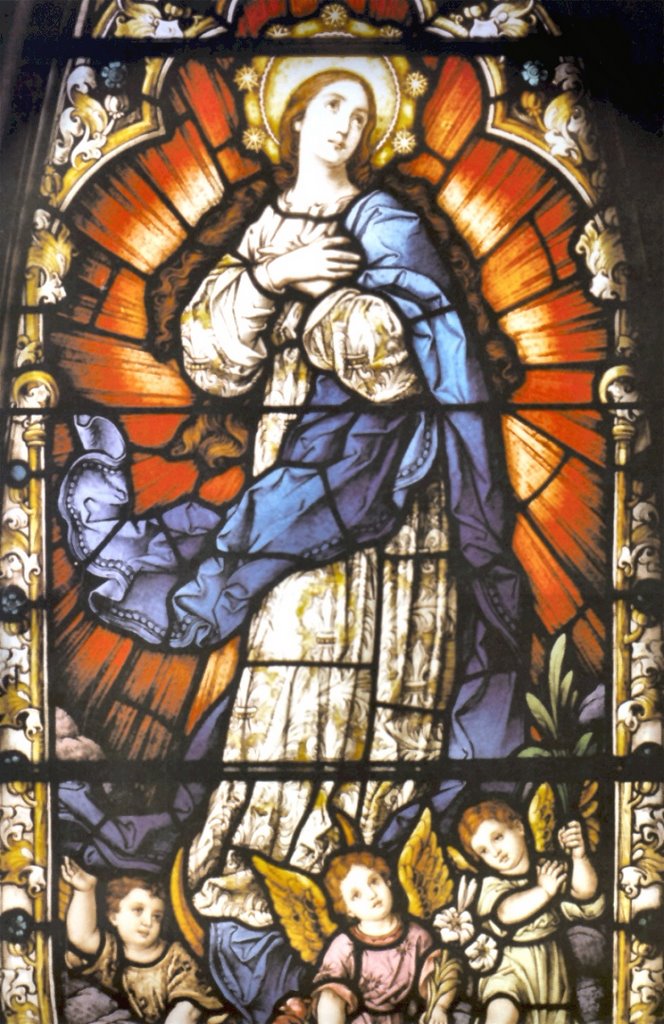
Devotion to the BVM

St. Louis De Montfort (+1710): “Where Mary is, there the evil spirit is not. One of the most infallible marks we can have of our being conducted by the good spirit is our being very devout to Mary, thinking often of her and speaking often of her.” (True Devotion to Mary #166)
“Saint Bonaventure said (in his Psalter) that whoever neglected Our Lady would perish in his sins and would be damned… If such is the penalty for neglecting her, what must be the punishment in store for those who actually turn others away from their devotions!” (The Secret of the Rosary, p. 30.)
“… many others have proved invincibly, from the sentiments of the Fathers (among others, St. Augustine, St. Ephrem, St. Cyril of Jerusalem, St. Germanus, St. John Damascene, St. Anselm, St. Bernard, St. Bernardine, St. Thomas and St. Bonaventure), that devotion to Mary is necessary to salvation, and that… it is an infallible mark of reprobation to have no esteem and love for the holy Virgin.” (True Devotion to Mary # 40)
“This [true] devotion [to Mary] consists, then, in giving ourselves entirely to our Lady, in order to belong entirely to Jesus through her. We must give her (1) our body, with all its senses and its members; (2) our soul, with all its powers; (3) our exterior goods of fortune, whether present or to come; (4) our interior and spiritual goods, which are our merits and our virtues, and our good works, past, present and future… and we must do it, further, without pretending to, or hoping for, any other recompense for our offering and service except the honor of belonging to Jesus Christ through Mary and in Mary…” (True Devotion to Mary #121)
“Let us conclude this point by giving the gist of all that has been said so far. He who prays is certainly saved. He who does not pray is certainly damned.” (St. Alphonsus, The Great Means of Salvation and Perfection, p. 30)
Subscribe to:
Posts (Atom)